To order a copy of the The Brave New World of Goan Writing & Art 2025, contact Dogears Bookshop Margao.
Fiction
By Nilankur Das
You had to be mad to take the pills and the syrups the way they did, deliberate madness. They weren’t chasing a high, they were trying to fall off the edge of the world, strip after strip of Spasmo Proxyvon, swallowed dry, Corex syrup guzzled warm and metallic, a haze of Benadryl and the white pill, Nitrazepam.
By Cordelia B. Francis
Verek’s eyes searched the horizon for the slightest sign of rain. Her old dog Balu crouched next to her, calm and alert. The horizon was a flat line. It shimmered in the afternoon heat. It had been this way, unchanged for years. The day Verek’s husband and son died, along with most of the men of the village, was also the day the land and the sky drained of colour.
non-Fiction
By R. Benedito Ferrao
The illustrated book The Story of Janakye Bai (Goa 1556, 2026) chronicles a tale that has been passed down over several generations amongst Velip people, one of Goa’s Indigenous communities. The story revolves around Janakye Bai, a girl who chooses to run away from home rather than resign herself to a fate she refuses to accept. This book appears in two editions, one in Velip Konkani and the other in English. Vithai Zaraunker, a member of the Velip community and an Assistant Professor of Women’s Studies at the D. D. Kosambi School of Social Sciences and Behavioural Studies at Goa University, envisioned this book project…
By Ava Sherry
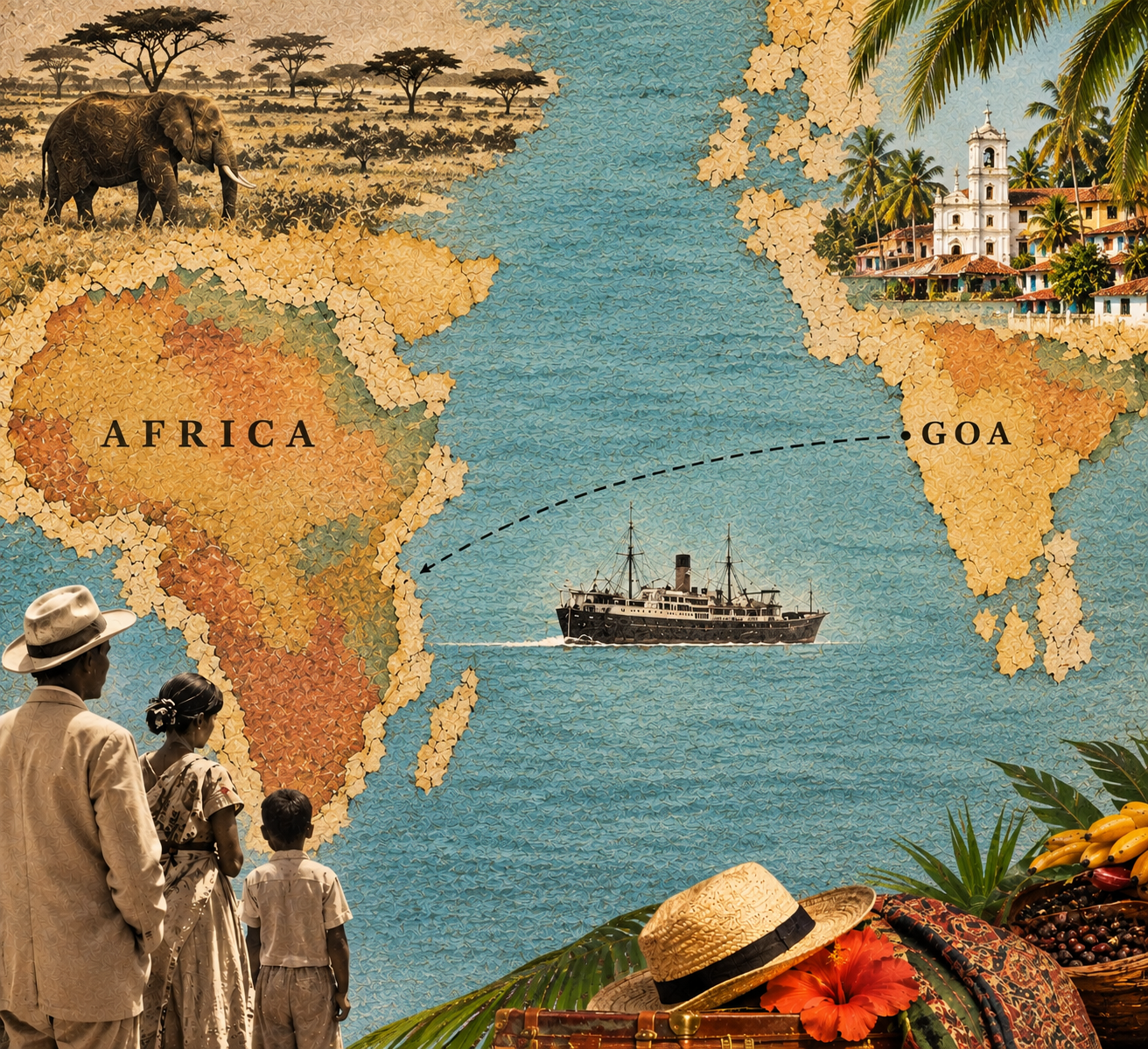
I had been drawn to R. Benedito Ferrão and Vamona Navelcar’s The Destination is the Journey, initially because it wasn’t obvious in its positioning. It felt almost like a puzzle, except with every answer found, another layer of depth revealed itself. The Destination is The Journey forms part of R. Benedito Ferrão’s edited book, Goa/Portugal/Mozambique: The Many Lives of Vamona Navelcar (2017) which is about a Goan artist – Navelcar (1929-2021) – whose life and identity, due to colonial forces, became dispersed across the boundaries of Africa, Asia, and Europe.
By Saachi D’ Souza
Growing up in the dominantly Hindu state of Gujarat, Christmas was more than gifts, family, and cheer. We found ways, albeit small, to bring us back to what was forced into suppression. Like most Catholic kids, I too took piano lessons. The one song that stuck with me was Auld Lang Syne. Every year, between the last carol and the first toast, the familiar melody begins. It isn’t, strictly speaking, a Christmas song. There is no Bethlehem, no manger, no snow. But Auld Lang Syne always arrives, as if called by the hush that settles over the world in late December.
poetry
By Suneeta Peres da Costa
I wander in the dark among the rooms in my
father’s house, touching talismans for blessings
and luck. Graffiti of old wounds cover the walls;
the ceiling sags and there are places where the
limestone is pocked and shell-shocked. We are
on land but the water is rising.
By Salil Charturvedi
The man sleeps on the rim of the pavement, one hand under his ear, legs bent. This is the shaded part of the esplanade. Now and then, a few bright-yellow flowers from the adjoining Copperpod tree fall and settle around him. His legs are draped with a faded blue-checked lungi and his skin is slightly darker than the tree’s shadow.
By Ashwani Kumar
I hear Columbus is in the city —
a sailor of ocean blue,
spilling secrets of his adventures to storm-starved skies.
Bells ringing, angels singing at traffic lights.
Persian pomegranate seeds scattered along the streets,
each a crimson promise of seers and saints.
book reviews & excerpts
Review by Michelle Mendonca Bambawale
Tale of Two Kitchens: A Culinary Journey through Cochin & Goa (Books etc., 2026), is a charming, all-colour tribute to the author’s life in food. Crescentia (Cres) Scolt Fernandes is an Anglo-Indian (of Portuguese and Dutch descent) chef and restaurateur, her husband Chrys is of Goan descent from Divar. She writes this memoir with recipes that document her history through two cultures on the same coast—Kerala and Goa.
Review by Selma Carvalho
Imagine the fear that pervaded Goa in the December of 1961. At least one section of Goan society knew with absolute certainty that their lives would change forever. It sometimes amuses me when we speak of Goan identity and its imminent loss. Goa has always had a plurality of identities coexisting. The culture of the Konkani speaking agriculturist mundkar in rural Goa is as divorced from the Portuguese-speaking Goan of literary societies and leisure associations as it was from the Marathi speaking Goan of the hinterland.
Review by Michelle Mendonca Bambawale
During the pandemic, Sharbelle discovered a shoe box tied in a faded red satin ribbon stuffed with a few of her parents’ letters to each other. The paper was frail, the handwriting faded, but the box had survived seventy years, shifting times and places, harsh Goan monsoons and a termite infestation. Reading them, Sharbelle learned about her parents lives before they had even met each other. She says in the Prologue, “of the hundreds of letters Mum Marge wrote over the span of six years, only fifty or so survived the termites’ assault. Of Dad Rodrigos’ only three.”
Banner image by Karolina Badzmierowska and downloaded from unsplash.com
The views expressed by contributors do not necessarily reflect those of the Joao Roque Literary Journal. They are here in the spirit of free speech to evoke discussion. Free speech is the pillar of a free society. You can write to lescarvalhos@yahoo.com if you wish to lodge a complaint.
By Jessica Faleiro
Angelica D’Sa is depressed. She’s the baby of the family. I couldn’t say she’s ever been overlooked, but it’s obvious to us that she’s been like this for a very long time. I first noticed it when she was twenty-two. Roxy says twelve. Mama insists that she was always a quiet child. It’s possible that we’re all right. More likely, we’re all wrong.